 |
 |
|
|
|
Welcome to the Website for N5814L The Online Refurbishment Record of 1972 Grumman AA-5 Traveler N5914L Serial Number AA5-0014 |
 |
|
Galleries |
|
Links |
|
|
|
What's the scope of this project and do we really want to get
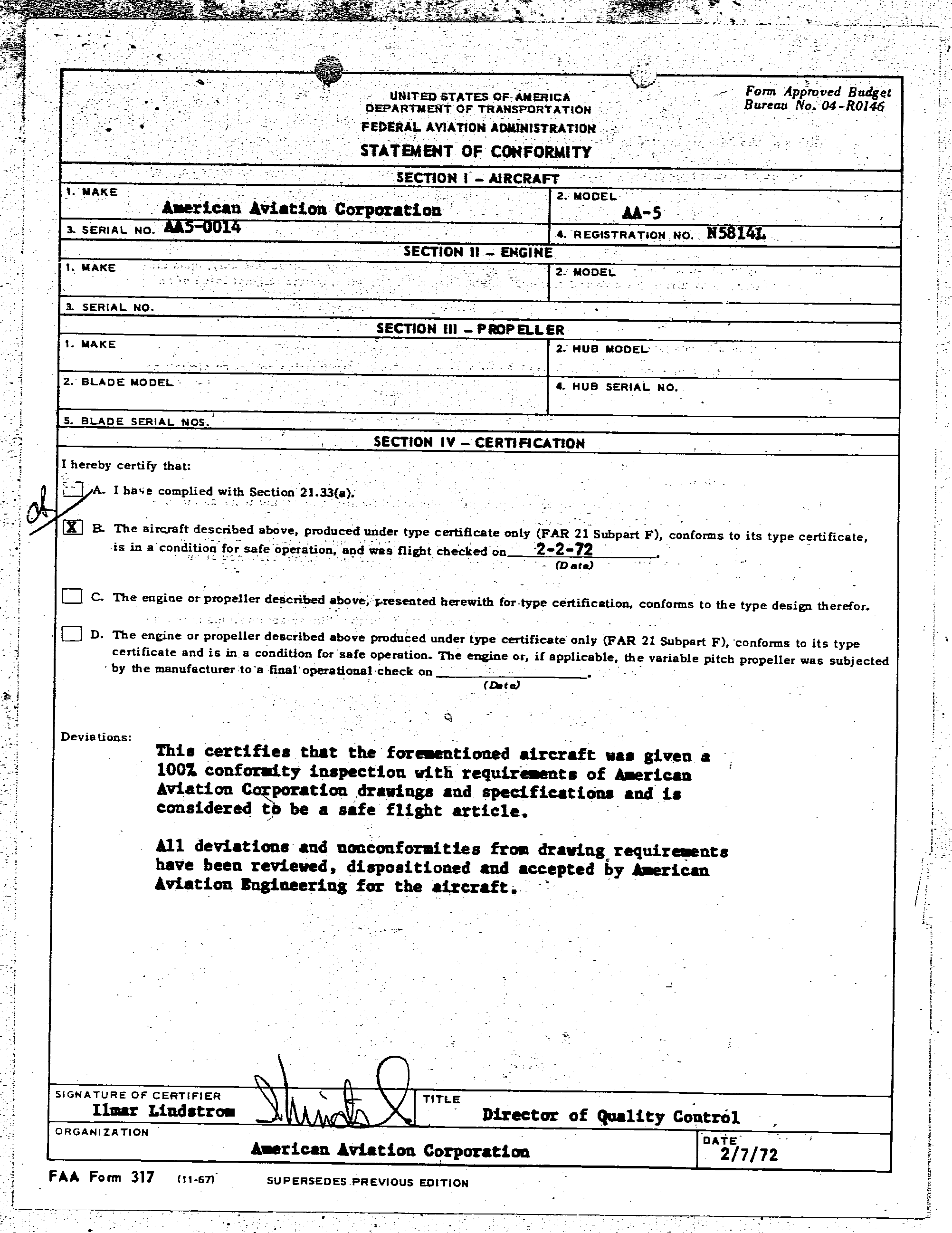
involved? So, here we have American Aviation AA-5 Traveler S/N AA5-0014 N5914L. Production and FAA flight checks completed February 2, 1972 and conformity check certificate issued the same day. The standard airworthiness certificate was issued five days later. |
 |
|
A former employer once taught me that within 30 minutes of accepting a customer's aircraft, the cowling must be removed and the oil should be draining. This way, even/especially when viewed from a distance, it is evident to the owner that work has begun. Then it's considered fine to go about more pressing matters. In this case, I was the customer and so I went one better. We quickly found that the #1 cylinder seemed "soft" by thumb compression when compared to the other three, so I pulled the jug to get a peek into the bottom end and try to get a sense of what had been going on for the past half decade since the engine had run. Some curious things turned up, but no deal breakers. |
 |
|
My prospective partner (Darryl) and I proceeded to pull all the covers, tips, and everything that would be required to be opened for an annual inspection. Without regard to whether we decided to make an offer, I was going to need one. |
 |
|
As we worked our way around the plane over the course of a couple of Saturdays and probably about 25 people hours, we found evidence of badly leaking fuel tanks, a few regions of delaminating in the rudder trailing edge, and general shift from what a appeared to be a high standard of maintenance toward more of a tie-wrap it and fly-on philosophy. |
 |
|
One biggie was the engine... the firewall forward, really. The engine had undergone a "field overhaul" in 1994. Regrettably, the documentation was spotty. For example, there was a notation in the engine log that the crank had been sent out for "Magnafluxing," but no serviceable tag could be located. There was no indication that the crankcase had undergone any inspection. While some FAA 8130 "yellow tags" were present, the list was hardly comprehensive. Given that the recommended calendar time between overhauls (TBO) had lapsed in 2006, the engine apparently hadn't run since no later than 2003, and the sketchiness of the field overhaul documentation, I declared the engine a run-out. Darryl and I agreed that, if we purchased 14L, it would be majored prior to its next startup. When I got round to pulling the oil screen, pretty much every crumb and flake in it jumped right to the pickup magnet. There wasn't a lot of material, but it was enough to justify my admonition to Dave that, whatever happened with respect to us as buyers, he urge the owners to not run the engine before it had been torn down and inspected. Finally, among the things that was perfectly well documented about the the overhaul was the mechanic's lien. A neglected airplane that needs an engine and doesn't have a clear title. I told myself that this actually was why I had gotten my A&P. |
 |
|
By the end of two weekend's worth of work, I was half way to a hundred write-ups. A few were pretty significant; but (except for the engine) they mainly appeared to involve a bunch of labor . As long as I never punched a clock and billed myself, I could pretend like I was getting a free mechanic. Don't get me wrong. 14L was going to consume a good chunk of change to get back into conformity with it's Type Certificate, and we'd budget in some modest avionics and appliance upgrades along the way too. We hoped that it wouldn't eat our lunch too quick. I took a deep breath, wrote up my inspection summary and my offer and proceeded to wait for a response. About a month after the initial offer went in, our offer was accepted. Two weeks later, Darryl and I signed the papers and became the new stewards of N5814L. |
 |
This page last updated on 08/06/2018